
 Image 1 of 1
For price inquiries and more information about this item, please contact Hera at contact@heraantiques.com and please indicate which item you are interested in.
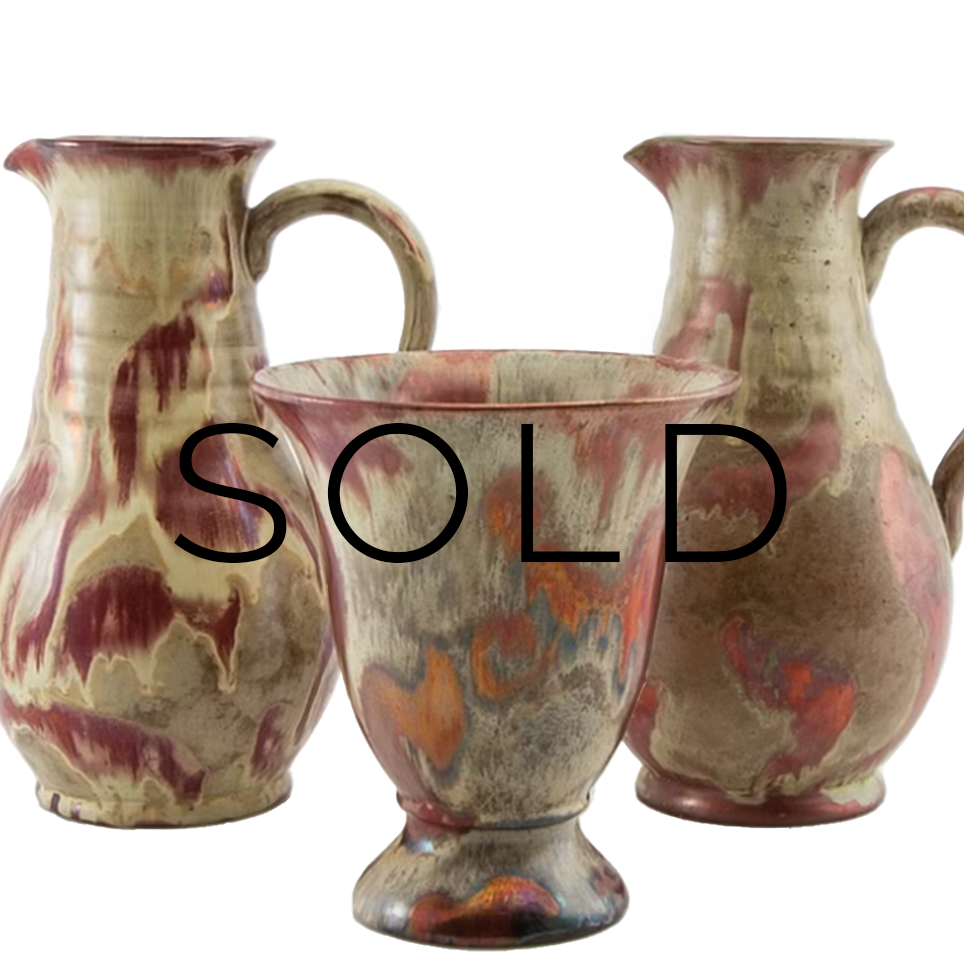
Height approx. 17-24 cm.
Insignificant surface wear.
Andersson & Johansson
The company that later became Höganäs Keramik was founded in 1909 under the name Andersson & Johanssons Lergodsfabrik. Production began on a small scale but expanded rapidly, including participation in the Baltic Exhibition in 1914 and several factory expansions during the 1920s–1940s. In the 1930s, the company launched its first original collections, and after World War II the product range grew significantly.
In 1956, Andersson & Johansson acquired Höganäs Keramik, a company founded in 1930 by the Nyman brothers, and in 1967 the name Höganäs Keramik was adopted. During the 1950s and 1960s, several prominent designers were associated with the company, and iconic series such as Old Höganäs were introduced.
In the 1970s, production shifted entirely from earthenware to stoneware, along with a transition from artisanal craftsmanship to industrial manufacturing. The company later changed ownership several times, becoming part of BodaNova, then Iittala, and eventually the Fiskars Group. The Höganäs factory closed in 2008 and production was relocated abroad. The Höganäs Keramik brand was discontinued in 2014 and continues today as a product line under Rörstrand.
Height approx. 17-24 cm.
Insignificant surface wear.
Andersson & Johansson
The company that later became Höganäs Keramik was founded in 1909 under the name Andersson & Johanssons Lergodsfabrik. Production began on a small scale but expanded rapidly, including participation in the Baltic Exhibition in 1914 and several factory expansions during the 1920s–1940s. In the 1930s, the company launched its first original collections, and after World War II the product range grew significantly.
In 1956, Andersson & Johansson acquired Höganäs Keramik, a company founded in 1930 by the Nyman brothers, and in 1967 the name Höganäs Keramik was adopted. During the 1950s and 1960s, several prominent designers were associated with the company, and iconic series such as Old Höganäs were introduced.
In the 1970s, production shifted entirely from earthenware to stoneware, along with a transition from artisanal craftsmanship to industrial manufacturing. The company later changed ownership several times, becoming part of BodaNova, then Iittala, and eventually the Fiskars Group. The Höganäs factory closed in 2008 and production was relocated abroad. The Höganäs Keramik brand was discontinued in 2014 and continues today as a product line under Rörstrand.
For price inquiries and more information about this item, please contact Hera at contact@heraantiques.com and please indicate which item you are interested in.